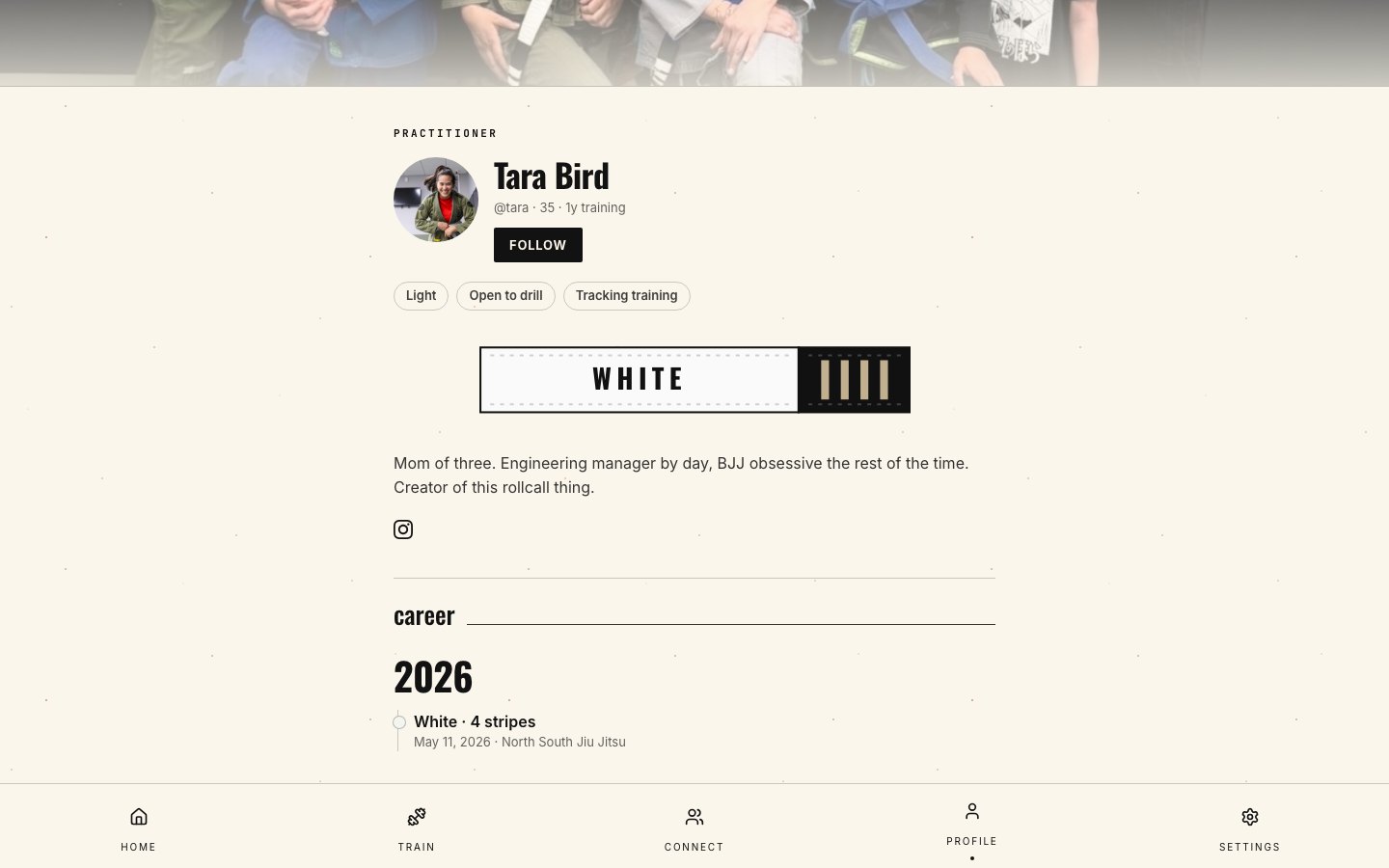
What it does
Rollcall is the training log I always wanted for jiu-jitsu. And a soft community layer on top.
You log every roll (your training partner, what you worked, how it went), track your belt progression, and over time build a real record of who you train with and what you’re working on. It’s social without being a social network: you can follow practitioners, see who’s at your gym tonight, and connect with people you’ve actually rolled with.
Why I built it
A year into my jiu-jitsu obsession, I had a year of training and almost zero record of it. I knew who I’d rolled with the last week, maybe. I had no sense of what I’d been working, what was getting better, or what was still a hole.
The existing options were either generic habit trackers (no concept of “rolling partner” or “submission attempt”), or pen-and-paper logs (don’t work for the social side). I wanted something purpose-built for the sport.
So I built it. And then realized other practitioners had the same problem.
How it works
Pretty standard modern web app:
- Next.js for the frontend and API routes
- Supabase for postgres, auth, and storage (profile photos, gym banners)
- React Hook Form + Zod for form validation
- React Google Maps for the gym-location features
- Playwright for end-to-end tests covering the critical user flows (sign up, log a roll, follow a practitioner)
- Vitest for unit tests on the business logic (belt progression, weekly summaries)
- Sentry for error tracking in production
- pnpm workspaces monorepo so a future mobile app can share the same data layer
The data model is the interesting part. A “roll” is a first-class entity that connects a date, two practitioners, a set of techniques drilled, and a vibe score. Everything else (your belt history, weekly summaries, partner suggestions, gym presence) is a view on top of that single entity.
What I’m proud of
- The belt visualization. It’s a single horizontal SVG that reads “WHITE” or “BLUE” with stripe indicators. It looks like the real thing. Practitioners get it instantly.
- The roll as a first-class entity. Made everything else easier. Weekly summaries write themselves. Partner suggestions become a single query.
- End-to-end coverage of the critical flows. Playwright covers sign up → log a roll → follow a practitioner. I’ve shipped during open mat with confidence.
- Privacy defaults. Profiles are private by default. You opt in to being discoverable. Took a lot of thought to get this right for a sport where people often have a public-private gradient.
What I’d do differently
Built the social features too early. The training log alone is the product for most practitioners. The community layer is what keeps people, but only after they’ve built a habit of logging. I’d ship just the log first, then layer in social.