What it does
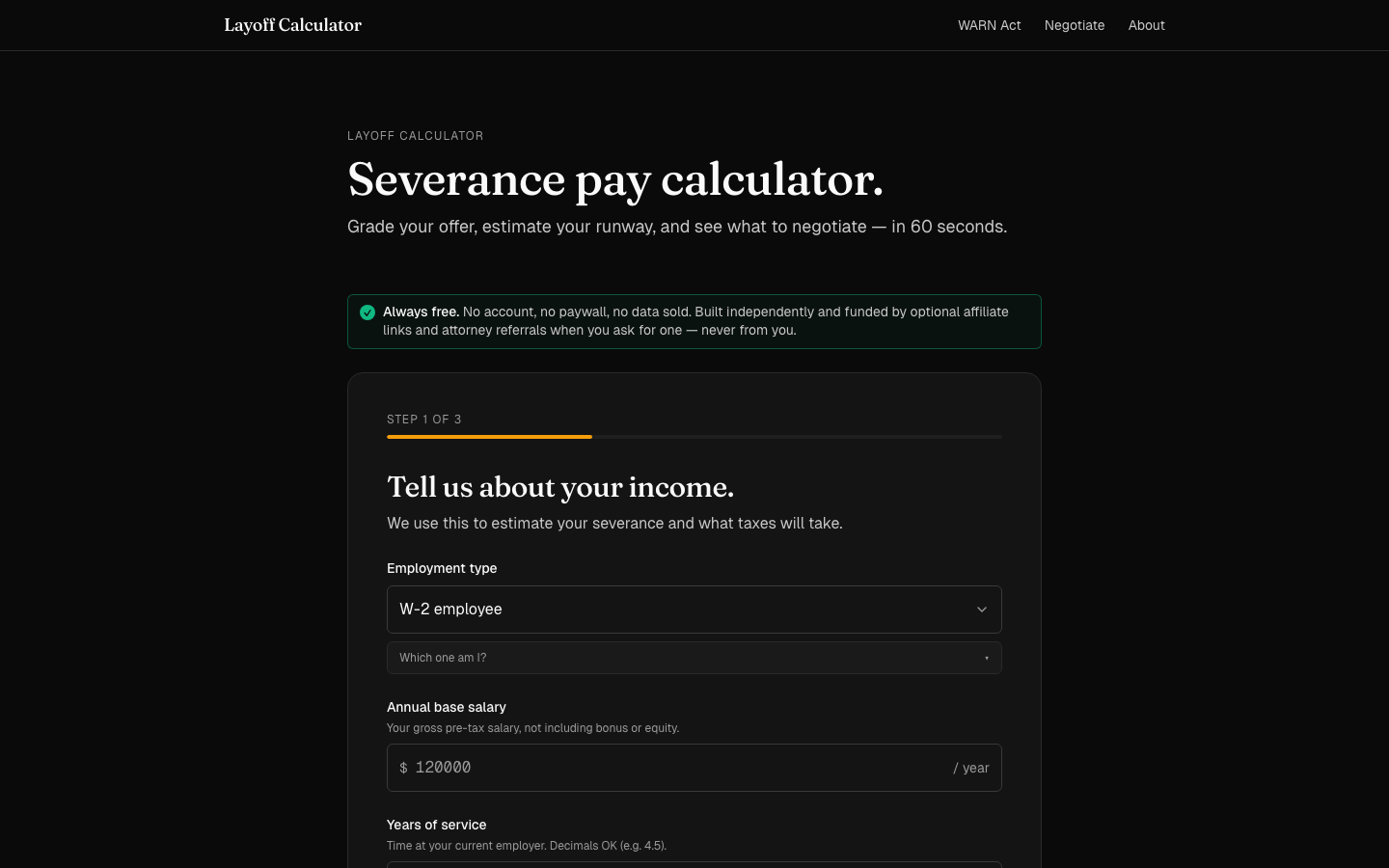
The Layoff Calculator grades a severance offer the way an experienced negotiator would. Fast, source-cited, free.
You paste in the numbers (base, bonus, equity, target separation date), it estimates your runway, models your equity (RSU/ISO/NSO), checks WARN Act eligibility for your state, and produces a one-page verdict you can take to your employer or an attorney.
No account. No paywall. No data sold. Funded entirely by optional affiliate links and attorney referrals you can choose to use. Never required.
Why I built it
A friend got laid off in the 2023 round of layoffs and texted me a screenshot of their offer with one question: “is this fair?” I couldn’t answer it confidently in under an hour. That bothered me.
The existing tools were either calculator-shaped lead-gen for law firms, or paywalled, or used decade-old WARN Act data. There was no public, source-cited, free tool that just answered the question.
So I built one.
How it works
The hard part of this product isn’t the math. The hard part is earning the user’s trust in the numbers.
Every claim on the site (a state law, a WARN Act threshold, a tax rate, a typical severance multiple) is anchored to a public source. The build pipeline enforces this: if a claim doesn’t have a citation, the build fails. If a citation can’t be reached at build time, the build fails. If a citation’s content has materially changed since I last verified it, the build flags it for review.
Behind that, a content refresh pipeline keeps state-by-state data, WARN Act guidance, and the equity modeling current. (I’ll skip the implementation details here. The whole point is that you should trust the numbers because of the visible citation, not because of how the pipeline works.)
The math itself runs entirely in the browser. The Supabase backend handles only optional things: saved scenarios for returning users, and aggregate (anonymized) usage data so I can see which fields are most-used and what’s broken.
What I’m proud of
- The trust gates. Every visible number traces to a public source you can click. The build literally refuses to ship if that breaks.
- The verdict format. Most calculators dump a table at you. This one renders a single-page verdict (the negotiation move, the runway estimate, the state-specific caveat) in a way you can show your employer.
- Equity modeling that doesn’t lie. RSUs, ISOs, NSOs, and acceleration clauses all behave differently at separation. The calculator handles each correctly and shows its work.
- Zero account required. You can use the entire product without giving me a single piece of personal information.
What I’d do differently
Started building the content pipeline before I had enough public-source-citation patterns to base it on. Rebuilt it once I knew what the rules should actually be. If I did it again, I’d hand-curate the first 50 claims, see the pattern, then automate.